As Amazon Associates, we earn from qualifying purchases. This means we may receive a small commission at no extra cost to you if you click through and make a purchase.
Mobile professionals, frequent flyers, and digital creators faced with cramped airplane tray tables, crowded airport terminals, and compact coffee shop setups increasingly look toward wearable displays to expand their screen workspace without packing bulky portable monitors. When exploring virtue ar glasses—a frequent search term for VITURE wearable displays—the buying decision centers on balancing visual dimensions against pack weight, optical acuity against host battery drain, and direct plug-and-play simplicity against advanced multi-screen spatial workflows. Transporting a pocketable eyewear frame that projects a private theater display or virtual dual-monitor workstation onto your retinas can fundamentally streamline how you edit video on long flights or review code across remote accommodations.
The current hardware catalog from VITURE is organized by optical architecture, onboard processing capability, and distinct mobile creator use cases. Entry into the ecosystem begins with featherweight frames engineered primarily for physical comfort and built-in optical dials, transitions into expansive cinematic displays boasting wide viewing angles and hardware-level image anchoring, and culminates in spatial computing flagships armed with integrated depth sensor cameras for gesture-controlled navigation. Conducting a methodical viture ar glasses comparison highlights noticeable differences in virtual canvas size, electrochromic tint switching, and desktop software integration, making it straightforward to establish which viture ar glasses to buy for your personal travel kit.
VITURE AR Glasses Lineup at a Glance
| Model | Display Specifications | Chassis Build | Key Travel Capability |
|---|---|---|---|
| VITURE Pro 2 XR AR Glasses | 146-inch, 1080p, 120Hz, 1600 nits, 50-degree FOV | 63 grams, ultra-thin hinges and temples | Built-in dual myopia dials (0 to -5.0D) |
| VITURE Beast XR AR Glasses | 174-inch, 1200p per eye, 120Hz, 1250 nits, 58-degree FOV | Sub-88 grams, aluminum-magnesium band | Hardware-based VisionPair 3DoF and 9-level dimming |
| VITURE Luma XR AR Glasses | 146-inch, 1200p, 120Hz, 1000 nits, 50-degree FOV | Lightweight frame, silicone band | Built-in -6.0D myopia dials and electrochromic film |
| VITURE Luma Pro XR AR Glasses | 152-inch, 1200p, 120Hz, 1000 nits, 52-degree FOV | Translucent frame, dual IPD sizing options | Three-screen SpaceWalker productivity and DeltaE < 2 color |
| VITURE Luma Ultra AR Glasses | 152-inch, 1200p per eye, 120Hz, 1500 nits, 52-degree FOV | Triple-camera front array, translucent finish | Full 6DoF tracking, hand gestures, 35% lower display power draw |
The Models in Detail
VITURE Pro 2 XR AR Glasses

Best for: Ultralight travelers prioritizing minimal pack weight and comfort
Pros
- Featherweight 63g frame
- Built-in independent myopia dials
- Vibrant 1600 nits brightness
- SGS A+ eye comfort certified
Cons
- Limited to 1080p resolution
- Narrower 50-degree field of view
Weighing only 63 grams, the VITURE Pro 2 XR AR Glasses are the lightest and most compact wearable display in the lineup, making them an immediate standout for ultralight travel packing. The chassis is 20 percent lighter than the earlier VITURE Pro generation, featuring a 16 percent thinner frame and a 39 percent thinner hinge architecture that closely resembles standard sunglasses. Visuals are driven by custom Sony Micro-OLED panels delivering a 146-inch virtual display at 1080p resolution and a fluid 120Hz refresh rate. By calibrating color directly within the Micro-OLED rather than routing signals through a secondary color management processor, these glasses achieve vibrant color fidelity and an impressive 1600 nits of peak brightness across a balanced 50-degree field of view.
One of the primary travel advantages of the viture pro 2 xr ar glasses is the integration of independent rotary myopia dials above each lens. These twin dials allow users with nearsightedness between 0 and -5.0D to focus each eye individually without requiring corrective contact lenses or magnetic prescription inserts. While travelers needing optical correction for audio frames often consult guides on prescription meta glasses, VITURE integrates mechanical diopter dials directly into the chassis. The optical engine utilizes UltraClarity 3.0 birdbath engineering for consistent edge-to-edge sharpness, backed by SGS A+ Eye Care certification to reduce fatigue during extended work sessions on planes or trains.
On the software front, the glasses support real-time 2D-to-3D conversion driven by VITURE’s Immersive 3D engine, alongside full compatibility with the SpaceWalker utility across macOS, Windows, Android, and USB-C iPhone models. Because this model relies on standard 1080p resolution and birdbath optics optimized for extreme portability, it serves the minimalist nomad who wants the lowest possible carry weight. It yields to higher models in the lineup when a traveler demands larger virtual screen dimensions, native 1200p vertical space, or advanced physical 3DoF tracking built directly into the frame hardware without running background companion apps.
| Color | Black |
|---|---|
| Size | One Size Fits All |
| Dimensions | 6.68 x 5.91 x 1.97 Inches |
1 more published attribute
| Weight | 0.14 Pounds |
|---|
Specifications and price are read from the Amazon product listing, not measured by this site. Open the listing
VITURE Beast XR AR Glasses

Best for: Movie fans wanting massive screens without background apps
Pros
- Expansive 174-inch display
- Hardware-level VisionPair 3DoF
- 9-level electrochromic dimming
- Wide 58-degree field of view
Cons
- Sub-88g heavier chassis
- Lacks built-in optical dials
The VITURE Beast XR AR Glasses represent the brand’s largest virtual display format, projecting an expansive 174-inch screen with an industry-leading 58-degree field of view. Powered by latest-generation Sony Micro-OLED panels delivering 1200p resolution per eye at 120Hz, this model pushes peak brightness to 1250 nits. Audio output is reinforced by HARMAN AudioEFX drivers embedded in the temples, producing deeper low-end response and a wider acoustic stage that helps mask cabin drone during transit. Built with an aluminum-magnesium band, the chassis remains under 88 grams while incorporating tilt-adjustable arms and magnetic ergonomic nose pads.
What sets the viture beast xr ar glasses apart for mobile users is the onboard VisionPair 3DoF hardware processing. Unlike glasses that require computer background software to pin displays in physical space, the Beast executes screen anchoring, smooth follow modes, 32:9 ultrawide formatting, and side-display positioning directly inside the eyewear hardware. Furthermore, the lenses feature 9-level electrochromic dimming paired with auto-transparency controls. Rather than relying on passive photochromic treatments seen on everyday wearable tech like meta glasses with transition lenses, the glasses employ active electrochromic film that switches tint electronically with a single tap, shifting from transparent AR to full cinematic blackout without carrying separate physical lens clips.
To ensure comfortable sightlines for varying facial structures, the listing specifies two distinct chassis sizes: Regular for interpupillary distances up to 70mm and Large for measurements up to 74mm. The hardware has been utilized by organizations like NVIDIA and Stanford Medicine for surgical imaging and enterprise spatial research, illustrating its precision focus. This model is engineered specifically for travelers prioritizing massive visual immersion, broad viewing angles, and instant hardware-level display pinning. However, it concedes the ultra-thin 63-gram profile and built-in mechanical diopter dials found on the Pro 2, requiring prescription wearers to utilize magnetic prescription inserts.
| Color | Black |
|---|---|
| Size | Regular |
| Dimensions | 2.19 x 2.19 x 2.19 inches |
1 more published attribute
| Weight | 0.19 Pounds |
|---|
Specifications and price are read from the Amazon product listing, not measured by this site. Open the listing
VITURE Luma XR AR Glasses
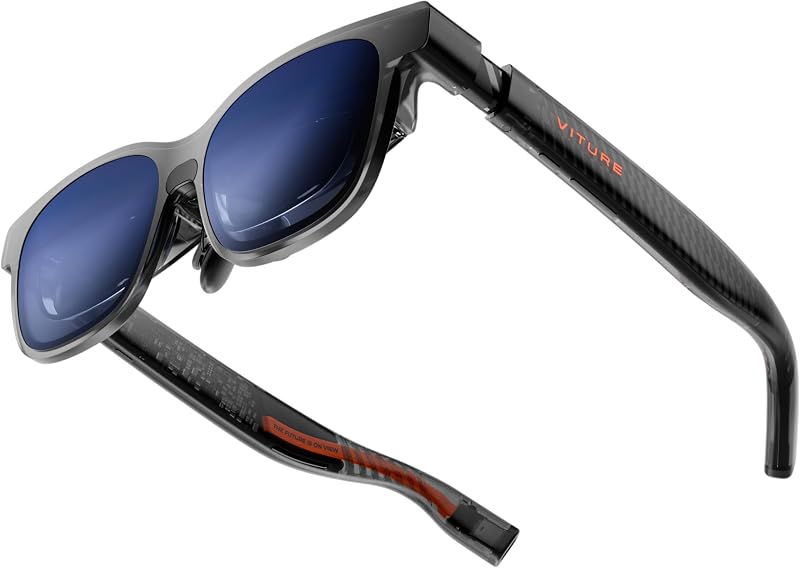
Best for: Writers and coders needing sharp text affordably
Pros
- Crisp 1200p resolution
- Deep -6.0D myopia dials
- One-tap electrochromic film
- Switch 2 and handheld ready
Cons
- Standard 50-degree viewing angle
- Silicone temple construction
The VITURE Luma XR AR Glasses provide a balanced stepping stone into 1200p high-definition wearable computing. Projecting a 146-inch virtual canvas with a 50-degree field of view and 1000 nits of peak brightness, the Luma elevates vertical text clarity over standard 1080p panels. Operating at a smooth 120Hz refresh rate, it provides sharp rendering across documents, code editors, and media playback. The physical design combines a lightweight frame with flexible arms and magnetic nose pads tailored to standard interpupillary distances between 56mm and 72mm.
A central attraction of the viture luma xr ar glasses is the integration of physical myopia adjustment dials offering an expanded range from 0 down to -6.0D, giving nearsighted travelers a full extra diopter of built-in correction compared to the Pro 2. The optical assembly also incorporates an electronic electrochromic film that darkens the outer shield with a single touch to block ambient airport lighting. Plug-and-play universal connectivity via USB-C DisplayPort Alternate Mode allows direct pairing with MacBooks, Windows laptops, iPad models, Android handsets, and mobile gaming devices like the Steam Deck without intermediary converter boxes.
For workflow multitasking on mobile desks, the glasses connect with the SpaceWalker desktop application to configure panoramic workspace environments across horizontal, vertical, and specialized coding arrangements. The listing also highlights gaming ecosystem integration, featuring partnerships with PXPlay, XBXPlay, 8BitDo hardware controllers, and compatibility with the Nintendo Switch 2. The Luma serves travelers who require razor-sharp 1200p typography and integrated diopter adjustment. It gives way to the Luma Pro when creators require wider viewing angles, Hollywood-grade color calibration, or multi-monitor virtual workspace expansion beyond basic layouts.
| Color | Black |
|---|---|
| Size | 146 inches |
| Dimensions | 1.97 x 2.2 x 6.1 inches |
1 more published attribute
| Weight | 0.17 Pounds |
|---|
Specifications and price are read from the Amazon product listing, not measured by this site. Open the listing
VITURE Luma Pro XR AR Glasses

Best for: Digital creators grading color on multiple screens
Pros
- DeltaE < 2 color accuracy
- Three-screen SpaceWalker support
- Upgraded HARMAN audio
- Dynamic translucent RGB frame
Cons
- Lacks integrated optical dials
- No onboard spatial cameras
Stepping up visual performance for mobile creators, the VITURE Luma Pro XR AR Glasses expand the virtual canvas to 152 inches while pushing the field of view out to 52 degrees. Utilizing 1200p resolution panels at 120Hz and 1000 nits of brightness, this model incorporates proprietary optical engineering designed to maximize perceived sharpness. It introduces Hollywood-grade color precision with a factory calibration rating of DeltaE < 2, ensuring that video editors, digital artists, and photographers traveling with portable laptops can evaluate color grading accurately inside a virtual studio.
Ergonomics and aesthetic customization receive notable updates on the viture luma pro xr ar glasses. The chassis features a premium translucent exterior housing customizable dynamic lighting effects that illuminate with synchronized color accents to reflect your gaming persona or productivity mode. Available in two distinct frame sizes to accommodate varied IPD measurements, the frame features tilt-adjustable temples, flexible arms, and magnetic nose pads for extended wear sessions. Audio performance is upgraded through an evolved HARMAN acoustic configuration that delivers crisper highs and elevated bass response for communication and entertainment.
Productivity is central to this model’s role as high-performance portable ar glasses for macbook and Windows machines. Through the SpaceWalker workstation platform, the Luma Pro can generate up to three distinct virtual displays arranged in horizontal, vertical, or dedicated coding orientations, allowing creators to inspect multiple application windows simultaneously without tab-switching clutter. Real-time 2D-to-3D conversion and gaming support for platforms including the Switch 2 round out its capabilities. The Luma Pro represents the ideal balance for professional multi-screen work, stepping aside only for the Luma Ultra when camera-driven 6DoF movement and gesture interaction are strictly necessary.
| Color | Black |
|---|---|
| Size | Regular |
| Dimensions | 6.1 x 1.97 x 2.22 inches |
1 more published attribute
| Weight | 0.17 Pounds |
|---|
Specifications and price are read from the Amazon product listing, not measured by this site. Open the listing
VITURE Luma Ultra AR Glasses
Best for: Spatial computing creators and power-conscious mobile professionals
Pros
- Triple camera 6DoF tracking
- 35% reduced display power draw
- High 1500 nits brightness
- Interactive hand gesture support
Cons
- Higher system processing demands
- Translucent shell adds aesthetic flash
At the apex of the manufacturer’s technological range, the VITURE Luma Ultra AR Glasses fuse high-end display optics with dedicated spatial computing hardware. Built upon a 152-inch virtual display running at 1200p per eye, 120Hz, and a wide 52-degree field of view, this model elevates brightness to an exceptional 1500 nits. Crucially for travelers managing battery life on host devices, the Luma Ultra introduces Sony’s latest Micro-OLED architecture, which slashes display power consumption by 35 percent compared to previous iterations while managing heat dissipation to maintain a cool frame temperature against the temples.
The defining capability of the viture luma ultra ar glasses is its integrated camera array, consisting of a front RGB camera alongside dual depth-sensing cameras. This triple-sensor hardware package powers true zero-drift six degrees of freedom (6DoF) spatial tracking and intuitive hand gesture recognition directly on the Android XR platform. Instead of relying solely on keyboard shortcuts or paired mouse inputs, travelers can interact with floating interface elements using natural hand movements in three-dimensional space, anchoring virtual browser panels, terminals, and video streams firmly against physical room geometry.
Alongside its spatial tracking capabilities, the Luma Ultra retains professional creative specifications, including Hollywood-grade DeltaE < 2 color accuracy, evolved HARMAN sound drivers, and a translucent housing with programmable RGB accent lighting. It also supports real-time AI 2D-to-3D content upscaling and SpaceWalker triple-monitor virtual workspaces on Mac and PC systems. For mobile developers, spatial computing enthusiasts, and remote professionals seeking maximum host device battery preservation alongside gesture-controlled spatial multi-tasking, this flagship stands at the top of the lineup, surpassing the lighter, display-only models that lack onboard spatial sensing cameras.
| Color | Luma Ultra XR Glasses |
|---|---|
| Dimensions | 6.1 x 1.97 x 2.22 inches |
| Weight | 0.18 pounds |
Specifications and price are read from the Amazon product listing, not measured by this site. Open the listing
Matching a Model to Your Setup
- Long-haul airplane travel where carrying the absolute minimum weight and having built-in myopia adjustment dials take precedence: VITURE Pro 2 XR AR Glasses.
- Direct console gaming, media consumption, and software-free 3DoF screen locking on passenger trains or hotel desks: VITURE Beast XR AR Glasses.
- Mobile software development and spreadsheet analysis needing crisp 1200p resolution and expanded -6.0D vision dials on a budget: VITURE Luma XR AR Glasses.
- Color-critical video editing and multi-window productivity using three virtual screens across a laptop workspace: VITURE Luma Pro XR AR Glasses.
- Advanced spatial computing exploration, natural hand gesture navigation, and extended laptop runtime via 35% lower display power draw: VITURE Luma Ultra AR Glasses.
Before You Buy
While VITURE wearable displays provide an expansive visual alternative to traditional travel monitors, prospective buyers must evaluate host hardware compatibility and real-world battery impact. These glasses do not house internal batteries; they draw operating power directly from the connected smartphone, handheld console, or laptop through a single USB-C cable supporting DisplayPort Alternate Mode. The manufacturer listings do not specify exact milliamp-hour power consumption rates across varying brightness levels or refresh rates for most models, with only the Luma Ultra citing a specific 35 percent panel power reduction. On battery-powered host devices such as phones or gaming handhelds, running high-brightness displays at 120Hz can accelerate battery depletion, making a pass-through charging dock or power-splitter accessory essential for cross-country flights.
Prospective buyers should also review physical vision correction details, audio leakage characteristics, and packaging inclusions before departing on trips. While the Pro 2 and standard Luma feature integrated diopter dials to correct nearsightedness, the listings do not specify astigmatism correction capabilities; users with significant astigmatism will likely need specialized magnetic prescription clip-ins. Furthermore, while the integrated open-ear HARMAN speakers deliver clear stereo audio, the listings do not quantify acoustic leakage levels in whisper-quiet environments like sleeping cabins or library reading rooms. If your mobile packing strategy leans towards ambient audio and casual recording rather than wearable productivity monitors, comparing display-focused XR gear against the meta glasses newest options will clarify whether you need full visual screen projection or simply voice-assisted smart eyewear. Finally, specific physical cable lengths and protective travel case dimensions are omitted from standard specification blocks, so verify your travel case footprint before packing.
FAQ
Can I use VITURE glasses as a portable AR display for MacBook multitasking?
Yes, all models in the VITURE lineup connect directly to modern Apple MacBook laptops via a standard USB-C port supporting video output. By utilizing the free SpaceWalker utility for macOS, models like the Luma Pro and Luma Ultra can generate up to three virtual displays anchored in mid-air. This setup enables developers, writers, and editors to organize multiple code windows, documents, and reference browsers side-by-side in panoramic or vertical layouts without carrying physical secondary monitors.
How does built-in myopia adjustment work on VITURE glasses?
Models such as the VITURE Pro 2 and VITURE Luma incorporate independent rotary diopter dials positioned directly above the lenses. These dials physically adjust the optical distance of the internal micro-OLED elements, allowing nearsighted individuals to dial in focus per eye independently (up to -5.0D on the Pro 2 and up to -6.0D on the Luma). This mechanical adjustment eliminates the need to wear prescription contacts or snap in secondary optical glass inserts, provided the user does not require substantial astigmatism correction.
What is the difference between 3DoF and 6DoF tracking in the VITURE range?
Three Degrees of Freedom (3DoF) tracking, found either via hardware in the VITURE Beast or via the SpaceWalker application on other models, tracks rotational movement: pitch, yaw, and roll. This allows virtual screens to stay locked in place as you turn your head, preventing the display from following every slight movement. Six Degrees of Freedom (6DoF), featured on the camera-equipped VITURE Luma Ultra, tracks rotational movement plus translational movement through 3D physical space: moving forward, backward, up, down, left, and right. This enables physical positional anchoring and interactive hand gesture tracking.
Do VITURE AR glasses require an external battery pack to operate?
None of the VITURE glasses feature an internal battery, keeping the physical frame weight down between 63 grams and under 88 grams for prolonged comfort. The glasses draw all necessary operating current directly from the connected USB-C host device, such as a laptop, tablet, or smartphone. When using host devices with smaller internal batteries on long trips, utilizing an accessory with power pass-through capabilities allows you to charge your device while simultaneously projecting video to the glasses.
How does electrochromic dimming compare to clip-on lens shades for travel?
Electrochromic dimming, featured on models like the VITURE Beast and VITURE Luma, uses an electronically controlled optical film layer integrated inside the outer glass. With a button tap on the frame, the lenses electronically transition from transparent glass to a heavily tinted shade—offering 9 distinct levels on the Beast—to block ambient cabin or sunlight reflections. This eliminates the need to carry, store, and manually attach fragile plastic clip-on shades while transitioning between productivity work and immersive movie viewing on the move.
Side by side
The 5 models above, lined up on the attributes that every one of them publishes, plus the score and listed price for all of them. Scores are out of 10, based on listed specifications and buyer feedback.
| Attribute | 01 Pro 2 XR AR Glasses | 02 Beast XR AR Glasses | 03 Luma XR AR Glasses | 04 Luma Pro XR AR Glasses | 05 Luma Ultra AR Glasses |
|---|---|---|---|---|---|
| Our scoreout of 10 | 8.4/10 | 9.2/10 | 9.2/10 | 8.6/10 | 8.4/10 |
| Color | Black | Black | Black | Black | Luma Ultra XR Glasses |
| Dimensions | 6.68 x 5.91 x 1.97 Inches | 2.19 x 2.19 x 2.19 inches | 1.97 x 2.2 x 6.1 inches | 6.1 x 1.97 x 2.22 inches | 6.1 x 1.97 x 2.22 inches |
| Weight | 0.14 Pounds | 0.19 Pounds | 0.17 Pounds | 0.17 Pounds | 0.18 pounds |
Attributes that only some of the models publish are left out of this table; they stay in each model’s own spec sheet above.