As Amazon Associates, we earn from qualifying purchases. This means we may receive a small commission at no extra cost to you if you click through and make a purchase.
Selecting the right desk chair requires balancing posture alignment, mechanical adjustability, and long-session breathability. For digital creators, remote editors, and workstation professionals, sitting for extended stretches places immense load on the lower back, neck, and shoulders. An effective ergonomic task chair must dynamically support spinal curvature during upright typing and deeper recline. Many buyers researching these designs encounter common typographical queries like the hdaba ergonomic office chair while looking for Hbada’s specialized spine-support engineering. Understanding how different lumbar mechanisms and cushion materials interact with your daily routine is critical before making an addition to your workspace. If you are also evaluating alternative brands in the ergonomic sector, reviewing a sihoo ergonomic office chair can provide useful context on how different makers calibrate task seating mechanics.
Hbada structures its ergonomic lineup into distinct tiers that range from conventional dual-back mechanical setups to motorized, sensor-driven models. A thorough hbada office chair comparison reveals that the entry-level tier emphasizes physical adjustability through multi-axis lumbar brackets and high-density foam padding. Moving up into the brand’s performance tier introduces floating three-zone lumbar wings that leverage body weight and gravity to adjust automatically. At the top of the range, advanced automated tracking models integrate active electronic sensors and therapeutic heating elements. Determining which hbada office chair to buy comes down to your personal balance of foam versus full-mesh seating, manual versus automated spinal tracking, and the specific footprint needed for your studio or office.
Hbada Ergonomic Office Chairs Lineup at a Glance
| Model | Lumbar Architecture | Armrest Motion | Primary Seating Surface |
|---|---|---|---|
| Hbada X7 Smart Ergonomic Chair | AI dynamic tracking with dual pressure sensors | 720-degree full-range articulation | 3-level ventilated comfort seat |
| Hbada E3 Pro 2026 Edition Ergonomic | Gravity-sensing 3-zone floating lumbar wings | 720-degree mechanical with 39-degree folding | High-elasticity CloudMesh with synthetic foam |
| Hbada P5 Ergonomic Office Chair | 3D adjustable dual-back support | 360-degree 3D motion (height, depth, rotation) | Micro-perforated elastic cushion with mesh back |
| Hbada E3 Air 2026 Ergonomic Office | 3-zone elastic lumbar system | 4D multi-directional adjustment | Full CloudMesh suspension seat and back |
The Models in Detail
Hbada X7 Smart Ergonomic Chair
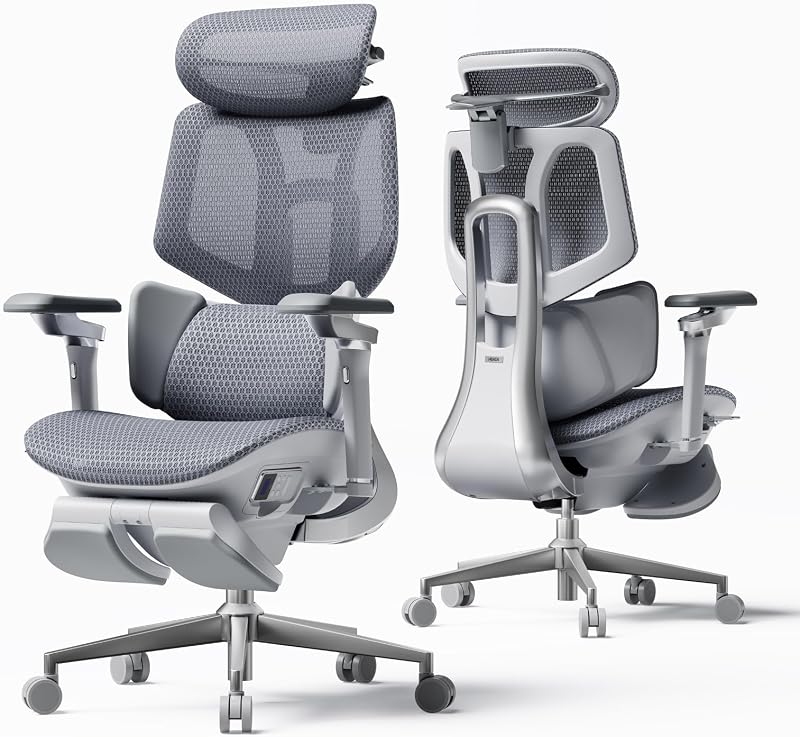
Best for: Professionals seeking automated electronic lumbar posture tracking
Pros
- AI-powered dynamic lumbar tracking
- Ventilated seat with three airflow levels
- Graphene heating and biomimetic massage
- Aerospace-grade aluminum frame construction
Cons
- Listing omits electrical power cord specs
- Higher complexity with motorized electronic components
The Hbada X7 Smart Ergonomic Chair represents the brand’s most technically intricate design, replacing passive mechanical springs with an active electronic support framework. At the core of the chair is an AI-powered dynamic lumbar support system equipped with dual pressure sensors and a high-speed intelligent control system. Rather than requiring manual adjustment dials, the X7 automatically detects changes in back pressure and physically tracks your movements whether you sit upright, lean forward to inspect video timelines, or recline during calls. The underlying frame is crafted from aerospace-grade aluminum, pairing structural rigidity with high-elastic breathable mesh across the back. This flagship model also incorporates an internal work recovery system featuring 8D biomimetic massage, graphene-based heating, and red light comfort technology to soothe tight back muscles between intensive work blocks.
Thermal control and articulation are heavily emphasized in the X7 specification list. The seat cushion integrates a three-level active ventilation system that circulates ambient air through the seating surface to prevent heat buildup during marathon desktop sessions. For upper-body positioning, the chair provides 720-degree adjustable armrests and a 4D headrest that accommodates complex seated postures. The synchronized recline mechanism supports multiple locked angles and variable seat depth adjustments to preserve healthy leg circulation. The manufacturer packages the unit with a dedicated gift set containing an insulated tumbler, an ergonomic neck pillow, and a sleep mask, signaling its role as an executive wellness workstation. Shoppers comparing high-end ergonomic setups can contrast this active electronic approach with passive alternatives highlighted in our mimoglad ergonomic office chair overview.
This automated flagship is tailored for creators, executives, and remote professionals who spend eight or more hours daily at a desk and require active lumbar intervention. If your workflow involves frequent shifts between upright keyboard tasks and reclined conceptual work, the automated sensor tracking eliminates the need to fiddle with manual knobs. However, the reliance on active internal electronics, ventilation motors, and heating elements means this chair requires access to power and brings extra mechanical complexity. For users who prefer purely mechanical, unpowered seating that achieves lumbar contouring without electrical components, the E3 series provides a more conventional hardware path.
| Color | Grey |
|---|---|
| Size | Medium (M) |
| Dimensions | 27.5 x 27.5 x 40 inches |
1 more published attribute
| Weight | 75 Pounds |
|---|
Specifications and price are read from the Amazon product listing, not measured by this site. Open the listing
Hbada E3 Pro 2026 Edition Ergonomic
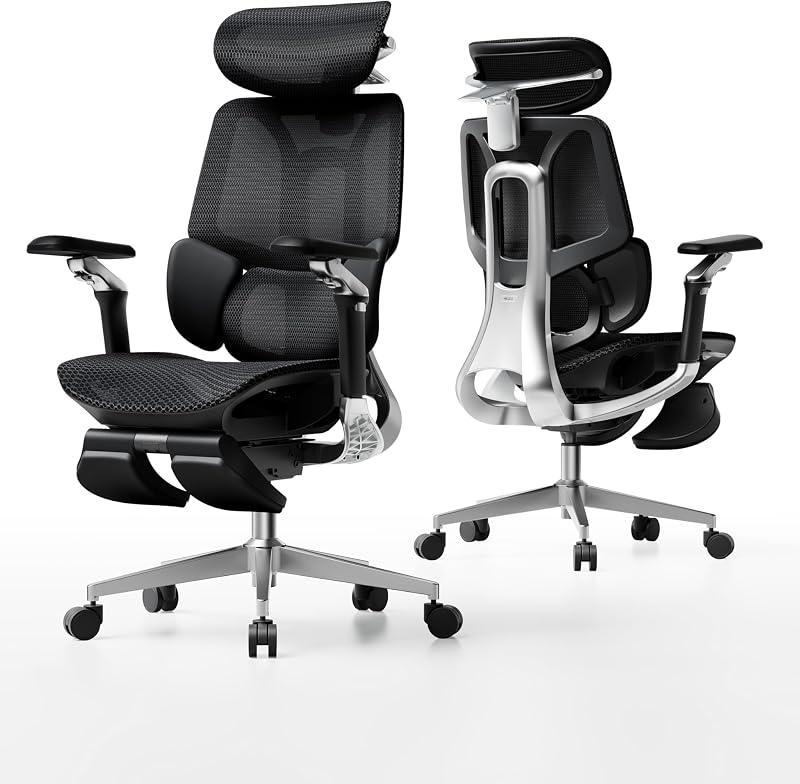
Best for: Creators wanting responsive gravity lumbar and folding armrests
Pros
- Dynamic 3-zone gravity lumbar wings
- 720-degree mechanical folding armrests
- Adaptive recline up to 140 degrees
- Five-year core structural warranty
Cons
- Foam seat retains more heat than mesh
- Integrated footrest adds under-seat mechanical bulk
The Hbada E3 Pro 2026 Edition Ergonomic focuses on high-performance mechanical engineering, utilizing body weight and gravity instead of electrical motors to adapt to your posture. The defining feature of this model is its dynamic three-zone floating lumbar support system. The assembly includes two lateral support wings that pivot between 40 and 80 degrees, wrapping around the lower torso while offering 60 millimeters of vertical height adjustment. This vertical travel specifically targets the L1 through L5 lumbar vertebrae to close the gap between your spine and the seat back. The chair relies on an adaptive recline chassis that accommodates angles from 105 degrees for focused typing up to 140 degrees for rest, using a gravity-sensing mechanism that automatically calibrates recline resistance based on the occupant’s weight.
Arm and neck support on the E3 Pro are built for multi-device workflows. The mechanical 720-degree armrests feature dual 360-degree rotational axes alongside 39 degrees of vertical folding, giving editors stable elbow support whether typing on a mechanical keyboard, sketching on a drawing tablet, or holding a mobile device. The upgraded 4D dual-axis headrest delivers 70 millimeters of depth travel, 40 millimeters of height adjustment, and 70 degrees of rotational tilt. The seat architecture pairs high-elasticity CloudMesh with a synthetic foam cushion foundation built on a polypropylene frame. Designed for individuals measuring between 5 feet 1 inch and 6 feet 5 inches (155 to 195 cm), the chair includes 80 millimeters of backrest adjustment, 50 millimeters of seat depth adjustment, a fold-out footrest, an SGS-certified Class 4 gas lift, and BIFMA-compliant structural durability backed by a five-year structural warranty.
The E3 Pro is an outstanding choice for video editors, graphic artists, and software developers who want extensive physical customization and firm lower-back wrapping without the electronic components of the X7. Its multi-angle folding armrests make it exceptionally well suited for setups requiring close proximity to desk surfaces or non-standard arm angles. Users who want the multi-zone lumbar design of the E3 platform but prefer a completely mesh seat surface rather than a padded synthetic foam cushion should look toward the E3 Air variant instead.
| Brand Name | Hbada |
|---|---|
| Age Range Description | Adult |
| Included Components | No components included |
24 more published attributes
| Indoor Outdoor Usage | Indoor |
|---|---|
| Model Number | E3 Pro 2026 |
| Material Type | Polypropylene |
| Seat Material | Fabric, Polypropylene |
| Fill Material | Synthetic Foam |
| Upholstery Fabric Type | Mesh |
| Color | Black |
| Back Style | Mesh Back |
| Style Name | Upgrade with Footrest |
| Pattern | Solid |
| Shape | Rectangular |
| Arm Style | Track |
| Leg Style | Straight Leg |
| Form Factor | Recliner |
| Item Dimensions D x W x H | 27.5"D x 27.5"W x 40"H |
| Size | 27.5" x 27.5" x 40" |
| Seat Depth | 1.97 inches |
| Item Depth | 27.5 inches |
| Item Dimensions | 27.5 x 27.5 x 40 inches |
| Reclining Position Count | 4 |
| Assembly Instructions Description | Attach legs with screws. Tighten using the provided tool. Insert backrest into seat frame. Secure armrests to sides using bolts. Attach casters to base. |
| Brand | Hbada |
| Material | Polypropylene |
| Product Dimensions | 27.5"D x 27.5"W x 40"H |
Specifications and price are read from the Amazon product listing, not measured by this site. Open the listing
Hbada P5 Ergonomic Office Chair

Best for: Home office workers preferring dual-back cushioned seating
Pros
- 3D adjustable height depth width lumbar
- Micro-perforated anti-flattening seat cushion
- 360-degree 3D adjustable armrests
- Recommended for hard floor office surfaces
Cons
- Narrower user height range up to 6’2″
- Lacks floating multi-angle lumbar wings
The Hbada P5 Ergonomic Office Chair delivers focused ergonomic fundamentals built around a dual-back architecture and high-resilience contact surfaces. Listed under model number P5 (with P501BMA references), the chair utilizes a 3D lumbar support module integrated into a split-back frame. This support structure adjusts independently across height, depth, and width, enabling users to fine-tune the pressure delivered to their lumbar spine. The backrest is framed with breathable mesh to encourage steady airflow, while the seat uses a high-resilience elastic cushion featuring a micro-perforated surface layer designed to resist flattening during workdays exceeding eight hours. It also includes an integrated footrest and a 2D adjustable headrest for reclined rest breaks.
Armrest versatility on the P5 emphasizes everyday desktop ergonomics. The 360-degree 3D adjustable armrests offer 7.5 centimeters of height movement, 4.2 centimeters of forward and backward travel, and full 360-degree rotation, allowing users to align the pads with desktop edges to relieve shoulder tension. The chair features swivel tilt mechanics and carries a specific surface recommendation for hard floors. In the manufacturer documentation, the package includes arm pads, a welcome guide, a three-year warranty, a 30-day return window, and a 15-day price match guarantee policy. Those cross-shopping entry-level task seating may find value in reading our misolant ergonomic office chair breakdown to compare split-back ergonomics across different brands.
The P5 fits home office workers and students measuring between 5 feet 4 inches and 6 feet 2 inches who want dependable, manual lumbar support paired with a traditional padded seat cushion. It serves as an accessible entry point into the brand’s ergonomic lineup for users who dislike the firm tension of all-mesh seat pans. Where the P5 yields to the E3 series is in its recline range and lumbar articulation; it lacks the floating lateral wings and expansive 720-degree folding arm articulation found on the higher-tier models.
| Color | Black |
|---|---|
| Dimensions | 10.85 x 10.85 x 19.45 inches |
| Weight | 44 pounds |
Specifications and price are read from the Amazon product listing, not measured by this site. Open the listing
Hbada E3 Air 2026 Ergonomic Office

Best for: Editors working long hours in warm studios
Pros
- Full CloudMesh seat and back suspension
- Gravity-sensing automatic recline tension
- 3-Zone elastic gap-filling lumbar
- Heavy-duty steel base and Class 4 lift
Cons
- No built-in heating or massage recovery tools
- Mesh seat tension feels firmer than foam
The Hbada E3 Air 2026 Ergonomic Office brings the brand’s three-zone posture architecture into a streamlined, all-mesh configuration. Finished in Pure Grey, this model utilizes a 3-Zone Elastic Lumbar System engineered to actively fill the lower back gap through multi-dimensional contouring. What separates the E3 Air from the E3 Pro is its seating material: both the backrest and the seat cushion are constructed entirely from breathable CloudMesh fabric. This suspended mesh design evenly distributes body weight across the seat pan to eliminate high-pressure zones under the thighs and hips, making it ideal for warm environments or users prone to overheating during long sitting periods.
Adjustability across the E3 Air is tuned for quick, intuitive operation. The chair incorporates a gravity-sensing chassis that automatically modulates recline tension up to 140 degrees without requiring manual tension knobs. The user simply leans back, and the mechanism counters their body weight for balanced transitions between upright focus and resting angles. Full-body adjustment points include a 4D headrest, 4D armrests, vertical backrest height settings, and seat depth adjustment. The core structural components include an SGS-certified Class 4 gas lift and a heavy-duty steel base tested against BIFMA standards, reflecting a ten-year durability design target.
This model is built specifically for programmers, digital editors, and creators who prioritize maximum thermal breathability and prefer the buoyant, suspended feel of a true mesh seat over foam padding. It retains the advanced spine-conforming principles of the E3 platform while stripping away excess weight and material bulk. If your routine demands specialized recovery tools like active seat ventilation, heating pads, or automated motor-driven posture tracking, you will want to step up to the flagship X7 instead.
| Brand | Hbada |
|---|---|
| Color | Pure Grey |
| Material | Polypropylene |
2 more published attributes
| Product Dimensions | 27.5"D x 27.5"W x 40"H |
|---|---|
| Back Style | Mesh Back |
Specifications and price are read from the Amazon product listing, not measured by this site. Open the listing
Matching a Model to Your Setup
- Professionals who want active, sensor-driven spinal alignment and built-in heating and massage for mid-day physical recovery should choose the Hbada X7 Smart Ergonomic Chair.
- Creators needing deep lateral lower-back wrapping, mechanical folding armrests for tablet drawing, and a cushioned foam base should opt for the Hbada E3 Pro 2026 Edition Ergonomic.
- Users working in warm home offices who require maximum airflow and suspended pressure relief across both the back and seat should select the all-mesh Hbada E3 Air 2026 Ergonomic Office.
- Workstation users seeking a dependable dual-back mechanical chair with a micro-perforated cushion optimized for hard floors will find the best fit in the Hbada P5 Ergonomic Office Chair.
- Multi-screen editors who switch frequently between typing, mobile editing, and reclined media viewing benefit most from the 140-degree tilt and 720-degree arms of the Hbada E3 Pro 2026 Edition Ergonomic.
Before You Buy
When selecting a chair from this lineup, pay close attention to dimensions and power requirements that the listings leave unstated. For instance, the Hbada X7 relies on active heating, red light technology, and motorized lumbar tracking, yet the product listing does not specify battery capacity, power cord length, or charging dock specifications. Similarly, while the E3 Pro and P5 specify user height ranges (5’1″ to 6’5″ and 5’4″ to 6’2″ respectively), exact minimum and maximum floor-to-seat heights are omitted from the main specifications table. Shoppers should measure their desk clearance and verify whether their workstation height can accommodate the chair’s armrest profiles in both lowered and raised settings.
Floor surface compatibility and caster construction also require careful thought. The P5 specifically recommends hard floor usage in its specifications, whereas the listings for the X7, E3 Pro, and E3 Air mention casters and heavy-duty bases without detailing wheel tread hardness or polyurethane coating. If you work on delicate hardwood or deep pile carpeting, you may need an aftermarket floor mat to ensure smooth rolling and surface protection. Reviewing the spatial footprint of compact alternatives in our dumos ergonomic office chair article can provide a helpful baseline for measuring tight home studio spaces before unboxing.
FAQ
What is the difference between dynamic lumbar support and fixed lumbar support?
Fixed lumbar support uses a static cushion or plastic bracket that stays in one position regardless of how you move, requiring manual repositioning when you change posture. Dynamic lumbar support, such as the floating three-zone system on the E3 series or the sensor-driven mechanism on the X7, automatically shifts and pivots as you lean forward or recline, maintaining continuous contact with your lower back without manual knob adjustments.
How do the 720-degree armrests function on the E3 Pro and X7?
The 720-degree armrests incorporate dual 360-degree rotational pivot points combined with vertical angle folding. This design allows the arm pads to slide forward, backward, inward, and outward, or pivot horizontally to support narrow arm positions when holding a mobile device or tablet. The folding mechanism also allows the armrests to tilt upward or downward, ensuring full elbow support at irregular desk heights.
Is an all-mesh seat better than a foam seat cushion?
An all-mesh seat, such as the CloudMesh construction on the E3 Air, offers superior ventilation and distributes body weight evenly to prevent heat accumulation during hot days. A foam cushion, like the synthetic foam on the E3 Pro or the elastic cushion on the P5, provides a softer, firmer base of support that some users find more comfortable for prolonged upright typing, though it retains more body heat than open mesh.
Does the Hbada X7 Smart Ergonomic Chair require regular charging?
Because the Hbada X7 includes motorized dynamic lumbar tracking, three-speed seat ventilation, graphene heating, and 8D biomimetic massage, it relies on internal electronic circuitry to power these functions. The product listing notes the automated capabilities and intelligent control system, but it does not specify exact runtime between charges or whether a permanent power cord connection is required for continuous operation.
Can the footrest on Hbada office chairs be removed if not needed?
The listings for the Hbada E3 Pro and Hbada P5 confirm that integrated footrests are included for relaxation and recline. These footrests are designed to slide out beneath the seat cushion and fold away when not in use, allowing normal upright sitting without interfering with leg clearance. The listing does not explicitly state whether the footrest rail assembly can be fully unbolted from the frame without affecting the chair’s structural integrity.
Side by side
The 4 models above, lined up on the attributes that every one of them publishes, plus the score and listed price for all of them. Scores are out of 10, based on listed specifications and buyer feedback.
| Attribute | 01 X7 Smart Ergonomic Chair | 02 E3 Pro 2026 Edition Ergonomic | 03 P5 Ergonomic Office Chair | 04 E3 Air 2026 Ergonomic Office |
|---|---|---|---|---|
| Our scoreout of 10 | 9.0/10 | 8.4/10 | 8.4/10 | 8.4/10 |
| Color | Grey | Black | Black | Pure Grey |
Attributes that only some of the models publish are left out of this table; they stay in each model’s own spec sheet above.