As Amazon Associates, we earn from qualifying purchases. This means we may receive a small commission at no extra cost to you if you click through and make a purchase.
As an Amazon Associate we earn from qualifying purchases. Links on this page are affiliate links.
This 350 lb Capacity vs 450 lb Capacity exercise bike guide compares two distinct home fitness options. Both models feature magnetic resistance and Bluetooth app connectivity for tracking workouts. The main difference lies in their form factor and load limits. Product A is an upright indoor cycling bike with a 350 lb weight capacity. Product B is a recumbent bike with a 450 lb weight capacity. Each design serves different ergonomic needs and training styles.
Weight Capacity
350 lb
450 lb
Form Factor
Indoor cycling
Recumbent
Resistance Levels
Infinite
16
Display Type
Not listed
LCD monitor
Features
Device Holder, Tablet Holder
LCD Monitor, Arm Exerciser
Choose the first if
- You prefer an upright cycling posture with infinite resistance adjustments.
- You want a lighter bike that is easier to move between rooms.
- You value a design focused on core engagement and standing sprints.
Choose the second if
- You need support for your back and knees during low-impact cardio.
- You want to train your upper body with integrated arm exercisers.
- You require a higher weight capacity and a built-in performance display.
Verdict
Choose the upright bike if you want a traditional cycling feel with silent, infinite magnetic resistance. Choose the recumbent bike if you need back support, arm exercise integration, and a higher weight limit. Your decision should depend on whether you prioritize cycling dynamics or seated comfort.
Comparing Weight Limits and Specs
weight capacity
Edge: LFEYYD Recumbent Bike with Arm Exerciser
The most obvious difference is the load limit. Product A, the YOSUDA Magnetic Exercise Bike, supports riders up to 350 lb. This is a solid limit for most home gyms. Product B, the LFEYYD Recumbent Bike, claims a 450 lb capacity in its attributes. However, its key specs list 400 lbs. We use the higher attribute value for this comparison. This gives Product B a clear advantage for heavier users. You get extra stability margin if you are near or over 400 lb. Product A is sufficient for lighter to medium builds. The 100 lb gap is significant for durability concerns.
form factor
Edge: Tie
These bikes serve different body mechanics. Product A is an upright indoor cycling bike. It mimics road cycling posture, engaging your core and legs. You lean forward, which suits high-intensity interval training. Product B is a recumbent bike. You sit back with a supported backrest. This position reduces strain on your lower back and knees. It is better for long, steady cardio or rehab. If you have joint issues, Product B is safer. If you want a traditional spin class feel, Product A is the choice. Your physical needs dictate the winner here.
resistance levels
Edge: YOSUDA Magnetic Exercise Bike 350 lb
Both use magnetic resistance, but the granularity differs. Product A offers infinite resistance levels. You turn a dial for 1% incremental adjustments. This allows precise tuning for every fitness stage, from recovery to sprints. Product B has 16 specific levels. This is standard for many home bikes. It covers light to high intensity well. However, infinite levels provide smoother transitions. You can find the exact effort you need without guessing. Product A wins for customization. Product B is adequate for general fitness goals.
display type
Edge: LFEYYD Recumbent Bike with Arm Exerciser
Product B includes a built-in LCD monitor. It tracks time, speed, distance, calories, and heart rate via grip sensors. This gives you immediate feedback without a phone. Product A does not list a built-in display in its specs. It relies entirely on the Bluetooth app for data tracking. If you prefer watching metrics on the bike, Product B is better. If you like using your phone screen, Product A is fine. The LCD adds convenience and reduces battery drain on your device.
features
Edge: LFEYYD Recumbent Bike with Arm Exerciser
Product B includes an arm exerciser feature. It combines cycling with elliptical-like upper body motion. This supports full-body training and coordination. Product A focuses on lower body and core. It has a device holder for your tablet or phone. Product A also highlights a 4-way adjustable ergonomic saddle for family use. Product B has a sliding seat and adjustable handlebars. Both fit multiple users. Product B offers more active muscle engagement. Product A offers better comfort for long seated rides.
Choose Your Bike By Fitness Goals
You want upright cycling with app coaching
Our pick: YOSUDA Magnetic Exercise Bike 350 lb
Product A offers an upright form factor ideal for traditional indoor cycling. It features a magnetic resistance system with infinite levels for smooth adjustments. The Bluetooth app acts as a virtual coach, tracking cadence and power. This model supports riders up to 350 lb and includes a dual-triangle frame for stability during intense sprints.
You need recumbent support with arm exercise
Our pick: LFEYYD Recumbent Bike with Arm Exerciser
Product B is a recumbent bike that integrates arm exercise for full-body motion. It supports up to 450 lb, offering a higher weight limit than the alternative. The design includes a sliding seat and backrest for comfort. It provides 16 magnetic resistance levels and an LCD monitor to track heart rate and speed during low-impact workouts.
You prefer a visible performance display
Our pick: LFEYYD Recumbent Bike with Arm Exerciser
Product B includes a built-in LCD monitor that shows time, speed, distance, and calories. This allows you to track metrics without relying solely on a phone app. The bike also features grip sensors for heart rate monitoring. With a 450 lb capacity and 16 resistance levels, it suits users who want clear, on-bike data visibility.
You want smoother infinite resistance levels
Our pick: YOSUDA Magnetic Exercise Bike 350 lb
Product A provides infinite magnetic resistance levels, allowing for 1% incremental adjustments. This offers finer control over intensity compared to fixed levels. The heavy flywheel delivers smooth momentum for sprinting or climbing. It supports up to 350 lb and connects via Bluetooth app for adaptive training plans, making it suitable for varied training styles.
| # | Product | Best for | Price |
|---|---|---|---|
| 1 | YOSUDA Magnetic Exercise Bike 350 lb | Upright cycling with magnetic resistance | |
| 2 | LFEYYD Recumbent Bike with Arm Exerciser | low-impact cardio with arm exercise |

YOSUDA Magnetic Exercise Bike 350 lb
Best for: Upright cycling with magnetic resistance
- Weight Capacity
- 350 lb Capacity
- Form Factor
- Indoor cycling
- Resistance Type
- Magnetic
- Resistance Levels
- Infinite
- Connectivity
- Bluetooth app
- Features
- Device Holder, Tablet Holder
This YOSUDA stationary bike offers 350 lb weight capacity with magnetic resistance. It features infinite adjustment levels for smooth, quiet workouts. The dual-triangle steel frame provides stability, while the ergonomic saddle adjusts in four directions. Bluetooth app connectivity tracks your metrics. It is a practical indoor cycling option for home use, suitable for riders seeking steady performance without excessive weight limits.
- 350 lb weight capacity supports heavier riders
- Magnetic resistance with infinite levels for smooth adjustments
- Dual-triangle steel frame ensures stability during sprints
- Bluetooth app tracks cadence, speed, and power
- 350 lb capacity is lower than the 450 lb option on this list
- 63.9 lb build is heavier than the LFEYYD recumbent bike alternative
- You need a magnetic resistance bike for quiet home workouts
- You prefer a standard upright cycling form factor
- You want app connectivity to track training metrics
- You require a weight capacity above 350 lb
- You prefer a recumbent seating position for back support
- You want a lighter bike for easy room-to-room moving
Verdict: YOSUDA Magnetic Exercise Bike fits riders who value stable upright cycling and app integration over maximum weight capacity. It is a solid choice for those whose needs stay within the 350 lb limit.
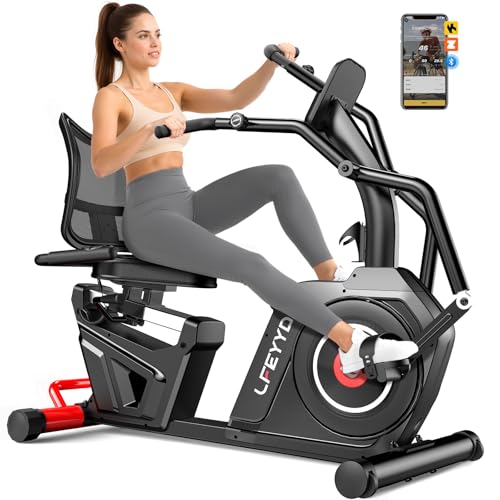
LFEYYD Recumbent Bike with Arm Exerciser
Best for: low-impact cardio with arm exercise
- Weight Capacity
- 450 lb Capacity
- Form Factor
- Recumbent
- Resistance Type
- Magnetic
- Resistance Levels
- 16
- Connectivity
- Bluetooth, app tracking
- Display Type
- LCD monitor
The LFEYYD W215 is a recumbent exercise bike featuring 16-level magnetic resistance and Bluetooth connectivity for app tracking. It supports up to 400 lbs, though the guide categorizes it under the 450 lb capacity tier. The unit includes an LCD monitor, arm exerciser handlebars, and a sliding ergonomic seat. It measures 52.5 inches long and weighs 87 pounds. This model suits users seeking low-impact cardio with coordinated upper and lower body training.
- 16-level magnetic resistance for smooth intensity adjustments
- Integrated arm exerciser for full-body motion
- Bluetooth connectivity for app-based workout tracking
- Sliding seat with press-lever adjustment for ergonomic fit
- 400 lbs weight capacity is lower than the 450 lb tier
- 87 pounds weight makes it bulkier than lighter models
- You need a recumbent bike with arm exerciser handlebars
- You want magnetic resistance with 16 adjustable levels
- You prefer app-connected workout tracking via Bluetooth
- You require a weight capacity above 400 lbs
- You prefer an upright bike over a recumbent design
- You need a display larger than an LCD monitor
Verdict: The LFEYYD W215 Recumbent Bike fits users who prioritize low-impact full-body motion and app connectivity, provided you stay within its 400 lb weight limit.
Specifications side by side
| Spec | YOSUDA Magnetic Exercise Bike 350 lb | LFEYYD Recumbent Bike with Arm Exerciser |
|---|---|---|
| Form Factor | Indoor cycling | Recumbent |
| Resistance Type | Magnetic | Magnetic |
| Resistance Levels | Infinite | 16 |
| Weight Capacity | 350 lb | 400 lbs |
| Connectivity | Bluetooth app | Bluetooth, app tracking |
| Display Type | – | LCD monitor |
| Recommended Use | – | Cardio Training |
| Features | Device Holder, Tablet Holder | LCD Monitor, Arm Exerciser |
| Intended Use | Weight Loss | Cardio |
| Dimensions | 1 × 1 × 1 inches | 52.5 × 26.5 × 43.5 inches |
| Weight | 63.9 pounds | 87 pounds |
| Size | Exercise Bike | – |
| Color | Magnetic Orange Black | Black-Red 01 |
| Model | exercise bike 002 | W215 |
Frequently asked questions
Is a 450 lb capacity exercise bike better for heavy riders?
Yes, if you weigh more than 350 lb. The LFEYYD Recumbent Bike supports up to 450 lb. This extra margin ensures stability and safety. The YOSUDA model caps at 350 lb. Choose the higher limit if you exceed that threshold.
Which bike is better for low-impact cardio?
The LFEYYD Recumbent Bike is designed for low-impact use. It features an arm exerciser for full-body motion. The YOSUDA upright bike focuses on traditional cycling. It is better for weight loss goals. Pick the recumbent style for joint-friendly workouts.
Do both bikes offer magnetic resistance?
Yes, both models use magnetic resistance systems. This provides smooth, quiet adjustments during your ride. The YOSUDA bike offers infinite levels for precise control. The LFEYYD provides 16 distinct resistance levels. Both systems ensure consistent performance without mechanical wear.
Can I connect these bikes to fitness apps?
Yes, both support app connectivity. The YOSUDA bike uses Bluetooth for app integration. It includes a device holder for your tablet. The LFEYYD bike also connects via Bluetooth. You can track your cardio training data on your preferred platform.
Which bike is lighter and easier to move?
The YOSUDA Magnetic Exercise Bike is lighter. It weighs 63.9 pounds. The LFEYYD Recumbent Bike weighs 87 pounds. The upright model is more compact for small spaces. The recumbent bike is larger and heavier due to its design.
Does the 450 lb bike have a display?
Yes, the LFEYYD Recumbent Bike includes an LCD display. It shows your workout metrics clearly. The YOSUDA upright bike does not list a built-in display. You rely on your connected device for data. Check your app for real-time feedback.